The productivity paradox
I've built two apps using AI. The first took months of copying code between ChatGPT and Xcode. The second was much easier. Codex did most of the work for me. But there's something strange about that progress. I understand how my first app works. With the second, I barely know where to start looking.
AI has transformed the way we work in ways I couldn't have imagined just a few years ago. I can generate an entire essay with a single prompt, create images and interfaces in seconds, and build apps without knowing how to code. That's amazing, right? I genuinely think it is. But it also got me thinking about how much emphasis we put on productivity. We celebrate the time saved and the things we can now accomplish, but pay much less attention to what happens to our skills when we increasingly rely on AI to do the work for us.
Learning to code, well…
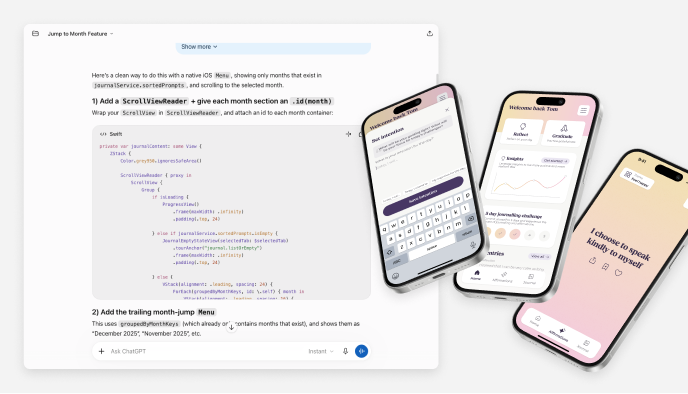
I've always enjoyed working independently. As a designer, being able to build my own apps without relying on developers felt liberating. I created Better, a journaling and affirmations app I use every day, and Campster, an app that helps people discover campsites that fit their preferences. Both were designed by me and built with AI, but the experience of creating them couldn't have been more different.
When I started building Better, AI coding tools were still relatively primitive. I spent countless hours copying code between ChatGPT and Xcode, figuring out where things belonged, fixing errors, and trying to understand how everything worked together. It was frustrating at times, but I learned a tremendous amount along the way. I understood how the app was structured, which files were responsible for what, and how different parts interacted.
By the time I started Campster, Codex had arrived. Instead of manually implementing code, I could simply describe what I wanted. Codex would create, modify, and maintain the codebase for me. Suddenly, I could build much faster and tackle things that would have been impossible for me before. Despite building a more ambitious product, I understand considerably less about how it actually works.
With Better, I could walk you through the codebase and explain how most things fit together. With Campster, I'd struggle to do the same. I've become much more capable of building software, but I'm not convinced I've become any better at writing it. The friction of building my first app forced me to learn. With the second, much of that friction disappeared. And so did many of the opportunities to develop my understanding.
Becoming a better researcher, well…
The same question applies to my work as a designer. I use AI almost every day. It helps me think through research plans, analyse interview transcripts, identify patterns, and turn findings into reports. Tasks that previously took hours can now be completed in minutes. And I love having those capabilities at my fingertips. It allows me to spend more time on other parts of my work and makes research more accessible.
But has it made me a better researcher? I'm not so sure. When AI identifies patterns in interviews, I might arrive at useful insights faster, but I spend less time looking for those patterns myself. And when AI helps structure a research plan, I can evaluate its suggestions without having to make every methodological decision from scratch.
Perhaps some of both. AI doesn't necessarily make us less skilled. But becoming more productive doesn't automatically mean we're becoming more capable either. We might be getting better at directing and evaluating work while becoming less practiced at doing certain parts ourselves. The question is whether that trade-off is one we're consciously making.
Have I become more skilled?
Looking back at these experiences, I've realised that being able to accomplish something isn't necessarily the same as knowing how to do it. AI has undeniably made me more productive. It has enabled me to build things I couldn't build before and accelerated work I was already doing. But I'm less certain about what I've learned in the process. And I can't imagine I'm the only one experiencing this.
As Christopher Noessel has argued in his work on AI interaction design, we should consider the relationship between humans and the systems we're designing, not just the tasks those systems help us complete. Yet much of the conversation around AI products focuses on speed, efficiency, and automation. How many hours can we save? How many tasks can we eliminate? How much more can one person accomplish?
Those are valuable questions, but they tell us very little about what happens to the person using the product over time. If an assistant makes decisions for us, we get fewer opportunities to practise making them ourselves. If it skips the steps that previously helped us learn, we might lose some of the understanding needed to critically evaluate its work. I'm increasingly interested in what that means for the way we design these tools.
Designing for more than productivity
I don't want this to sound pessimistic, because I'm genuinely excited about what AI makes possible. I wouldn't have built my apps without it, and I certainly wouldn't want to return to a world where these tools didn't exist. But I believe we, as designers, have a responsibility to think beyond productivity.
Perhaps a good AI assistant shouldn't always remove every bit of friction. Sometimes, asking a question instead of providing an answer might help someone think more critically. Explaining a decision rather than simply executing it might help someone develop a deeper understanding. And occasionally, encouraging someone to do part of the work themselves might be more valuable than doing it for them.
Of course, not every interaction needs to become a learning experience. Sometimes we just need to get things done. But I'd love to see more AI products that give people a choice in how much they want to delegate and how involved they want to remain.
When I look at Better and Campster, I'm proud of both. Campster is the more ambitious project, and I couldn't have built it without the capabilities AI gives me today. But there's something I miss about building Better. I remember spending hours figuring out why something didn't work, and the satisfaction of finally understanding it. These days, I can have Codex fix a problem without ever knowing what went wrong.
I enjoy being able to build more than ever before. I just don't want to lose the joy of figuring things out along the way.
